Skip to content
CrafterBy

Laser Cutting & Engraving cost & pricing calculator

$2.10 of acrylic.
The finished sign?
$8 to make.

File prep, laser time, mask removal, assembly. Price the work around the cut as carefully as the sheet itself.

This fictional USD example turns $2.10 of acrylic into $8 of listed costs. Use your own sheet prices, machine time, and finishing steps in CrafterBy.

Calculate my first product

Start free · Create an account, then add one product

Explore the cost example first
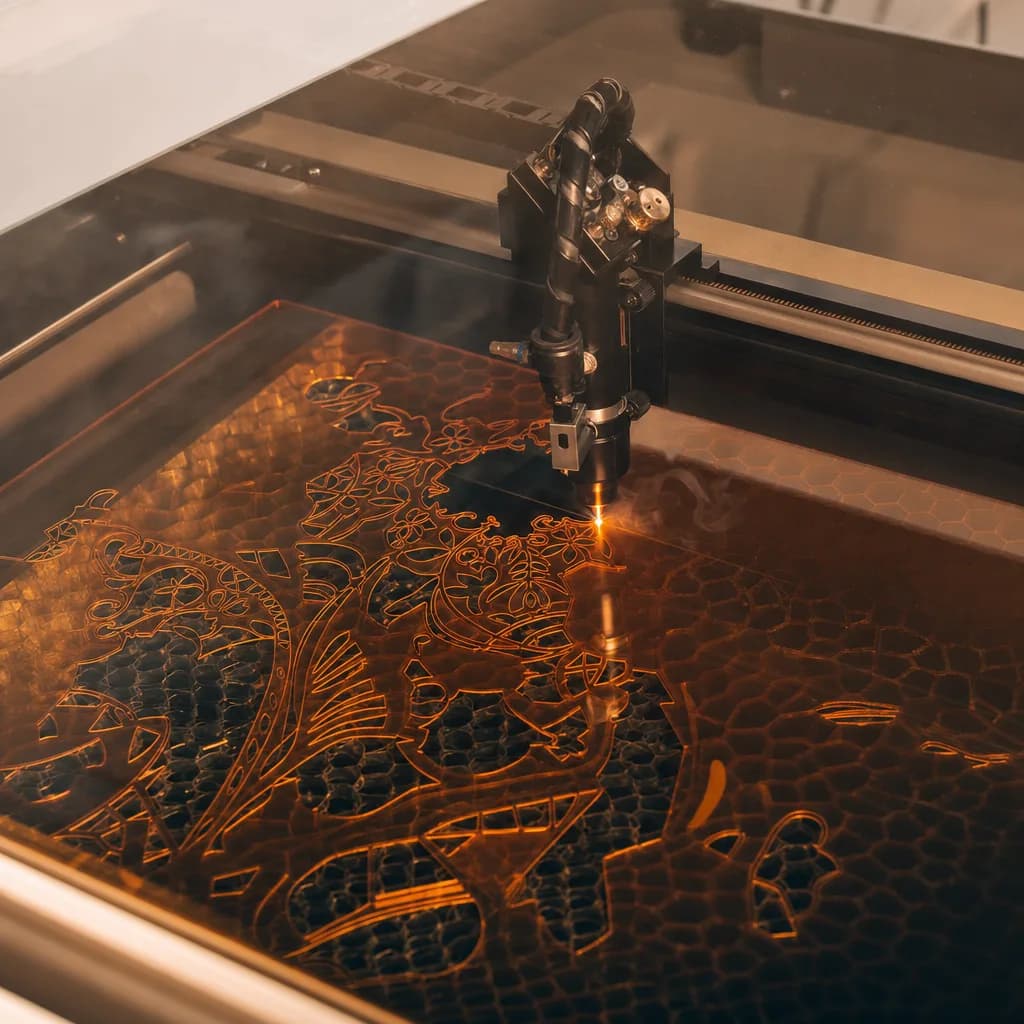
A laser cutter working on a sheet in a warm maker workshop
Made by you.Your price should include your work.

From making it to selling it

The laser stopped. The order is not finished.

The acrylic comes off the bed, but the masking still needs peeling. There are edges to inspect and parts to assemble. The customer expects a finished piece, not a pile of cut shapes. If the price came from sheet area alone, part of the job is already missing.

Personalized orders need file preparation and testing; the machine needs care between jobs. You need a repeatable way to count the sheet, the time at the laser, and the work around it. A small piece can still need a careful finish.

01 / Follow the work behind the price

The costs are specific.
Your calculation should be, too.

Start with the parts of your process that are easiest to leave out. Give each one a place in the cost of your finished product.

01

A sheet price cannot describe the cut

A simple outline and dense engraving can occupy similar areas but use different machine time. Nesting also changes usable yield. Material area cannot describe all the work specified by the file.

Put it in your calculation

Record material use and machine time as separate inputs.
02

Masking and assembly happen by hand

Peeling lettering, removing residue, gluing layers, and packing fragile shapes take attention after cutting. File preparation happens before the first test. Both belong to the product as much as the acrylic.

Put it in your calculation

Add preparation and finishing time before choosing the selling price.

03

Clean optics are part of making the next piece

Optics need inspection and cleaning, alongside other machine care. Supplies and upkeep do not vanish between invoices. Use assumptions that fit your equipment, rather than a generic tube-life claim from another workshop.

Put it in your calculation

Use your own equipment and maintenance assumptions.

02 / See what the price leaves you

One finished product.
The cost behind it.

This fictional personalized acrylic sign — fictional usd example includes the materials, work and equipment costs listed alongside it. They add up to $8.00. Your own process, purchase prices and hourly rate will change the result.

At $16.00, there’s $8.00 left.

That’s after the costs listed in this example. Any unlisted packaging, fees and other expenses still need to come out of it. Move the price to explore the difference.

Illustrative USD example. Your costs and selling price are yours to choose.

Anatomy of a price

Personalized acrylic sign — fictional USD example

Example · USD
Acrylic consumed
$2.10
Equipment + energy
$1.40
Active labor — 12 min at $18/hour
$3.60
Consumables + packing
$0.90
Cost in this example
$8.00
$16.00
$4.00Explore a selling price$24.00
Left after listed costs$8.00

50% margin
before other expenses

A fictional worked example, not a recommended price. Include any packaging, overhead, selling fees and applicable taxes not listed here before treating the remainder as profit. Changing the price doesn’t predict demand.

Make the next decision with the numbers visible

Quote the finished piece, not its footprint

Our fictional USD sign uses $2.10 of acrylic, $1.40 of equipment and power, $3.60 of labor, and $0.90 of consumables and packing: $8 before profit. Labor assumes twelve minutes at an illustrative $18 hourly rate. These are teaching values, not suggested shop rates.

Keep those inputs together in CrafterBy. Save a template, then change the material, size, or finishing time for another order. You can see which part of a customization changes the cost instead of adding an arbitrary amount.

Calculate my first product

03 / Put your costs somewhere useful

Know this product’s cost.
Keep it for the next order.

CrafterBy brings materials, active labor and equipment costs into a saved product. Explore the real app below.

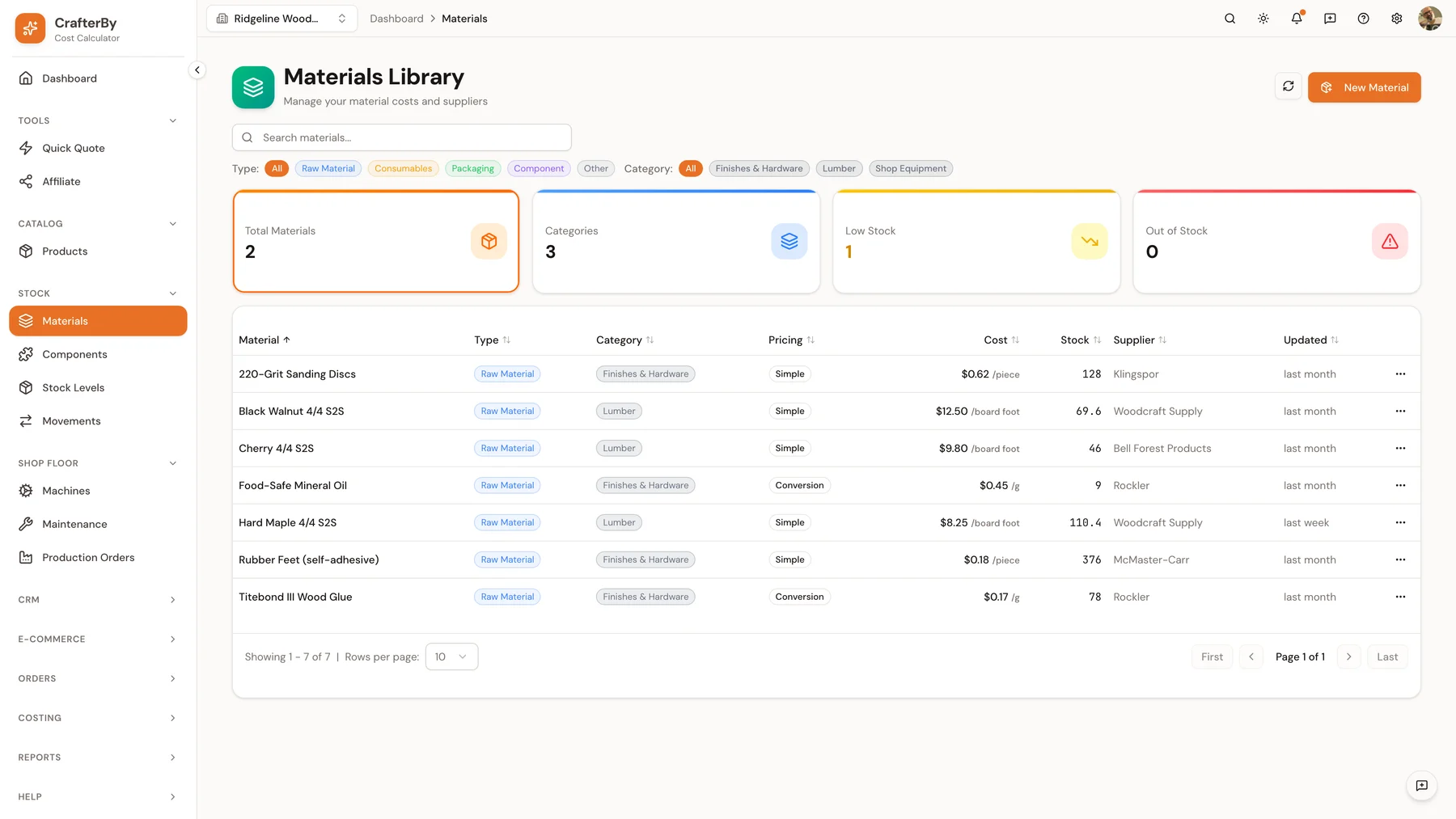
Keep plywood, acrylic, mdf and the other materials you use in one library. Record purchase prices and units, then use them in your product costs. Real app captures below contain sample woodworking data.

Inside CrafterBy / MaterialsActual app
CrafterBy’s Materials Library with unit prices, stock levels and suppliers in a sample woodworking account.

Your materials, organized · Real captures with sample woodworking data; your work uses the same tools.

View full size
Materials

Know what you paid and what you use.

Keep purchase prices, units and waste allowances with your materials. Buying a large pack and using a small amount should be part of the calculation, not another guess.

Product templates

Reuse the work behind the quote.

Save a familiar product’s materials and process as a starting point. Review the quantity, design and active time when the next order is different.

Cost & margin

Compare a price with the costs.

See what remains after the costs you entered. You choose the price; the breakdown helps you judge the work and the order before committing to it.

Before you make the next batch or quote

“I already charge by the laser minute.”

That can be a useful quoting rule. Check what the rate includes: power, equipment, upkeep, and perhaps your time. Then add the work it leaves outside, such as file preparation or packing.

Avoid counting an expense twice if it is already included in your rate. A cost model is useful because you can explain its ingredients. CrafterBy helps you organize those ingredients; it does not read the cut file or know your machine's future maintenance bill.

Your first step is small

Start with one product.
Build from what you know.

Revisit one personalized sign. Add the sheet consumed, machine time, and the minutes spent peeling, assembling, and packing it.

Create your free account, add the costs you know, then explore a selling price. Replace estimates with measured numbers as you learn from your own work.

Calculate my first product

Start free. See current plans and limits.

Before you start

Questions from your craft.
Answers you can use.

Can I use one rate for cutting and engraving?

A common equipment rate may work, but enter the time each operation needs. Similar areas do not guarantee similar run times. Review the estimate when artwork, material, or settings change.

Should I count a full sheet for one small piece?

Count material consumed and realistic waste; reusable stock can remain for another order. Do not assume every awkward remnant will sell, or charge material twice if it is already counted.

Does CrafterBy calculate CO2 tube life automatically?

Use equipment and maintenance figures you can support. This workflow does not promise tube-life detection or telemetry. Check the manufacturer's guidance and review assumptions against actual operation.

I’m only starting to sell. Is this for me?

Yes. You can begin with one product and the materials you already use. Revisit one personalized sign. Add the sheet consumed, machine time, and the minutes spent peeling, assembling, and packing it. You don’t need a team or a large catalog to start understanding your costs.

Is the money left after these costs all profit?

At a $16.00 selling price, $8.00 remains after the $8.00 of costs listed in this fictional example. Any packaging, overhead, selling fees, shipping you cover or applicable taxes not listed here can reduce that amount. Include your active labor as a cost too; it is separate from the margin left afterward.

Can I try it before choosing a paid plan?

Yes. Create an account and start free with one product. Check the pricing page for current plan features and limits. You can compare the process with your existing notes or spreadsheet before deciding what you need.

Your work deserves a price you understand

Make the product.
Know what it costs.

Start with your materials, your process and your time.
Give the next price a reason behind it.

Calculate my first product

Free to start · Your costs, your price, your decision