
Skip to content
CrafterBy

Candle Making cost & pricing calculator

$1.20 in wax.
The finished candle?
$8.59 to make.

You found the right fragrance. Now find the number behind every pour.

Fragrance, the vessel, wick, label, packaging and pouring time belong in the cost of this 8 oz candle, too. These are worked-example costs. CrafterBy helps you calculate yours.

Calculate my first product

Start free · Create an account, then add one product

Explore the cost example first
Hand-poured candles in glass vessels on a workbench with wax and fragrance bottles.
Made by you.The scent is yours. The numbers should be clear.

From making it to selling it

The shop wants your candles. You want to know what the order leaves you.

It is a good message to receive: someone wants a shelf full of your work. Then comes the wholesale question. You remember the wax price. The jars arrived in a different order. You still need to pack everything, and that new scent took several test candles before it became a product.

The excitement and the uncertainty can exist together. You do not need a different relationship with your craft. You need a complete cost for this candle, in this vessel, at the quantity you are actually being asked to supply.

01 / Follow the work behind the price

The costs are specific.
Your calculation should be, too.

Start with the parts of your process that are easiest to leave out. Give each one a place in the cost of your finished product.

01

A new scent is more than a new label.

Change the fragrance, wick or vessel, and you have a combination to test again. Those test pours use wax, jars and your attention before there is a finished candle ready to sell.

Put it in your calculation

Keep development costs visible alongside the repeat recipe. Decide how to cover them without counting them twice in every batch.
02

The jar gets a price. The small parts get forgotten.

A lid, wick, label and protective packing can each look too small to track. Together they belong to every candle that leaves the bench, including the ones bought by a stockist.

Put it in your calculation

Put components in your CrafterBy material library and use their actual quantities in the product cost.

03

A bigger order still needs a complete price.

Pouring several candles together may share preparation time. It does not remove the vessel from each unit or the work of preparing the shipment. A retail price cut in half cannot tell you whether the order fits.

Put it in your calculation

Review the order’s labor and packaging, then compare the proposed wholesale price with the cost it needs to cover.

02 / See what the price leaves you

One finished product.
The cost behind it.

This fictional 8 oz soy candle has a making cost of $8.59. The example brings the pour, the vessel, the smaller components and labor together. Try a selling price and see what remains for the other costs of running your business.

At $22.00, there’s $13.41 left.

That’s after the costs listed in this example. Any unlisted packaging, fees and other expenses still need to come out of it. Move the price to explore the difference.

Illustrative USD example. Your costs and selling price are yours to choose.

Anatomy of a price

8 oz soy container candle

Example · USD
Soy wax, 200 g @ $0.006/g
$1.20
Fragrance oil, 16 g @ $0.09/g
$1.44
Vessel + lid + wick + label
$3.85
Labor (pour + cure handling, per unit)
$1.75
Dye + consumables
$0.35
Cost in this example
$8.59
$22.00
$4.00Explore a selling price$33.00
Left after listed costs$13.41

61% margin
before other expenses

A fictional worked example, not a recommended price. Include any packaging, overhead, selling fees and applicable taxes not listed here before treating the remainder as profit. Changing the price doesn’t predict demand.

Make the next decision with the numbers visible

One recipe. A number you can come back to.

The fictional example on this page starts with $1.20 of wax and reaches $8.59 in listed making costs. That difference is the reason to look beyond the wax receipt. Your real candle will have its own ingredients, labor and remaining expenses.

Build it once in CrafterBy, then save a product template. Update purchase costs in your library and review the affected product. The margin tools help you compare prices; you decide what works for the order and your customers.

Calculate my first product

03 / Put your costs somewhere useful

Know this product’s cost.
Keep it for the next order.

CrafterBy brings materials, active labor and equipment costs into a saved product. Explore the real app below.

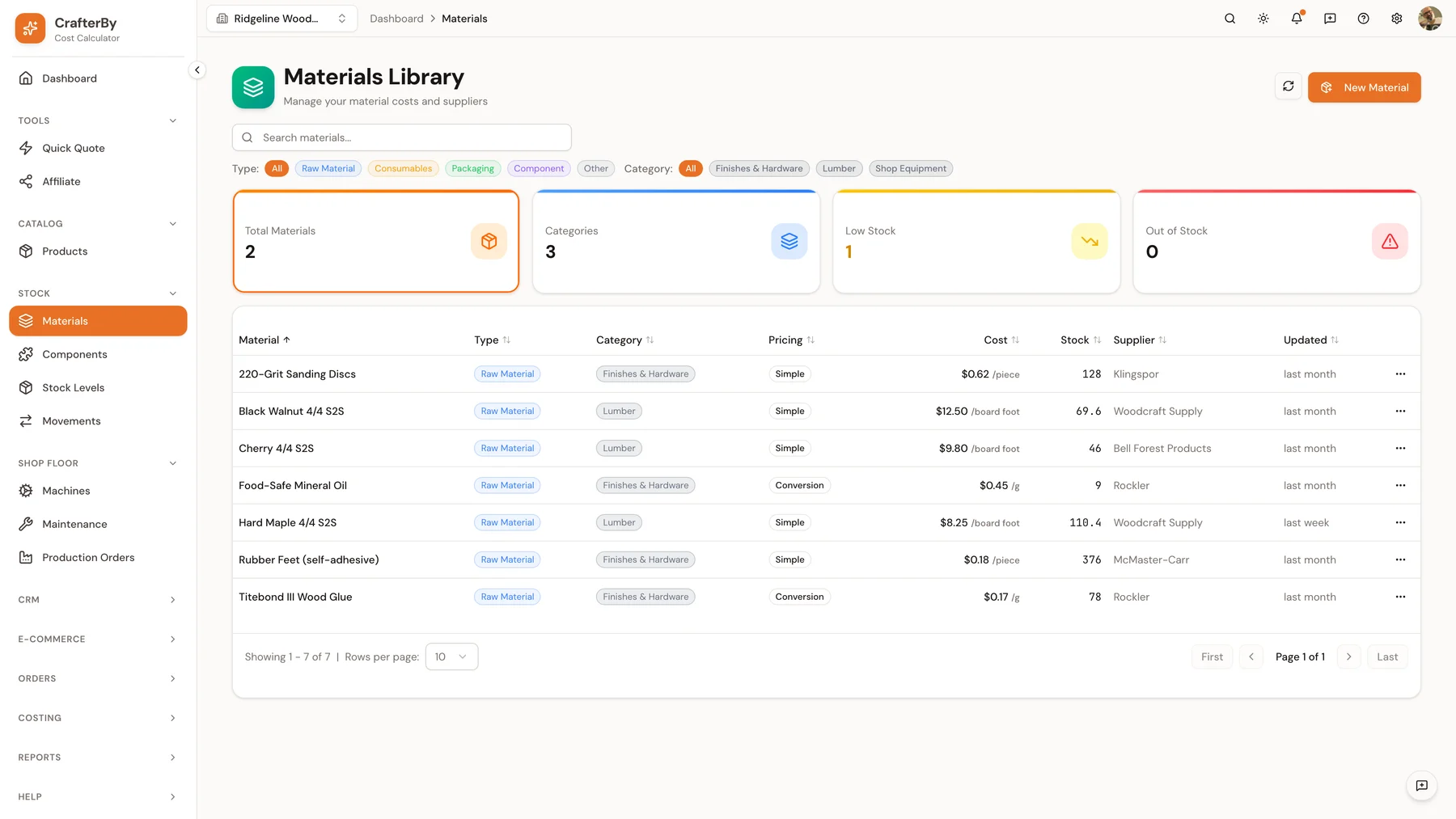
Keep soy wax, fragrance oil, wicks and the other materials you use in one library. Record purchase prices and units, then use them in your product costs. Real app captures below contain sample woodworking data.

Inside CrafterBy / MaterialsActual app
CrafterBy’s Materials Library with unit prices, stock levels and suppliers in a sample woodworking account.

Your materials, organized · Real captures with sample woodworking data; your work uses the same tools.

View full size
Materials

Know what you paid and what you use.

Keep purchase prices, units and waste allowances with your materials. Buying a large pack and using a small amount should be part of the calculation, not another guess.

Product templates

Reuse the work behind the quote.

Save a familiar product’s materials and process as a starting point. Review the quantity, design and active time when the next order is different.

Cost & margin

Compare a price with the costs.

See what remains after the costs you entered. You choose the price; the breakdown helps you judge the work and the order before committing to it.

Before you make the next batch or quote

“I cannot change every price every time I buy wax.”

You do not have to. Tracking a changed cost and changing a customer’s price are separate decisions. Knowing the difference gives you a chance to review the next order before agreeing to it.

Start with your best-known candle, not your whole collection. A reliable calculation for one repeat seller is useful immediately, and gives you a structure for the next scent.

Your first step is small

Start with one product.
Build from what you know.

Bring one tested recipe, its purchase costs and the active time for a normal batch. Use the free calculator to find the cost before choosing a selling price.

Create your free account, add the costs you know, then explore a selling price. Replace estimates with measured numbers as you learn from your own work.

Calculate my first product

Start free. See current plans and limits.

Before you start

Questions from your craft.
Answers you can use.

Do test candles belong in my costs?

Yes. Keep their materials and work visible as development costs, then choose a reasonable way to cover them. Do not treat every test as a saleable candle or add the same expense twice.

Can different scents share one selling price?

They can, but first cost each recipe. Different fragrance and component costs can leave different margins at the same price. The choice is clearer when you can see that difference.

Will the calculator tell me my wholesale price?

It helps you compare a proposed price with the costs you entered. Include the actual order’s packing and selling expenses. A calculation does not predict whether a retailer will accept the quote.

I’m only starting to sell. Is this for me?

Yes. You can begin with one product and the materials you already use. Bring one tested recipe, its purchase costs and the active time for a normal batch. Use the free calculator to find the cost before choosing a selling price. You don’t need a team or a large catalog to start understanding your costs.

Is the money left after these costs all profit?

At a $22.00 selling price, $13.41 remains after the $8.59 of costs listed in this fictional example. Any packaging, overhead, selling fees, shipping you cover or applicable taxes not listed here can reduce that amount. Include your active labor as a cost too; it is separate from the margin left afterward.

Can I try it before choosing a paid plan?

Yes. Create an account and start free with one product. Check the pricing page for current plan features and limits. You can compare the process with your existing notes or spreadsheet before deciding what you need.

Your work deserves a price you understand

Make the product.
Know what it costs.

Start with your materials, your process and your time.
Give the next price a reason behind it.

Calculate my first product

Free to start · Your costs, your price, your decision