Skip to content
CrafterBy

3D Printing cost & pricing calculator

$3 of filament.
The finished print?
$11 to make.

The spool is only the start. Price the preparation, machine time, and finishing that make a part ready to hand over.

In this fictional USD example, $3 of material becomes $11 of listed costs. Build your own version with CrafterBy using your quantities, equipment, and time.

Calculate my first product

Start free · Create an account, then add one product

Explore the cost example first
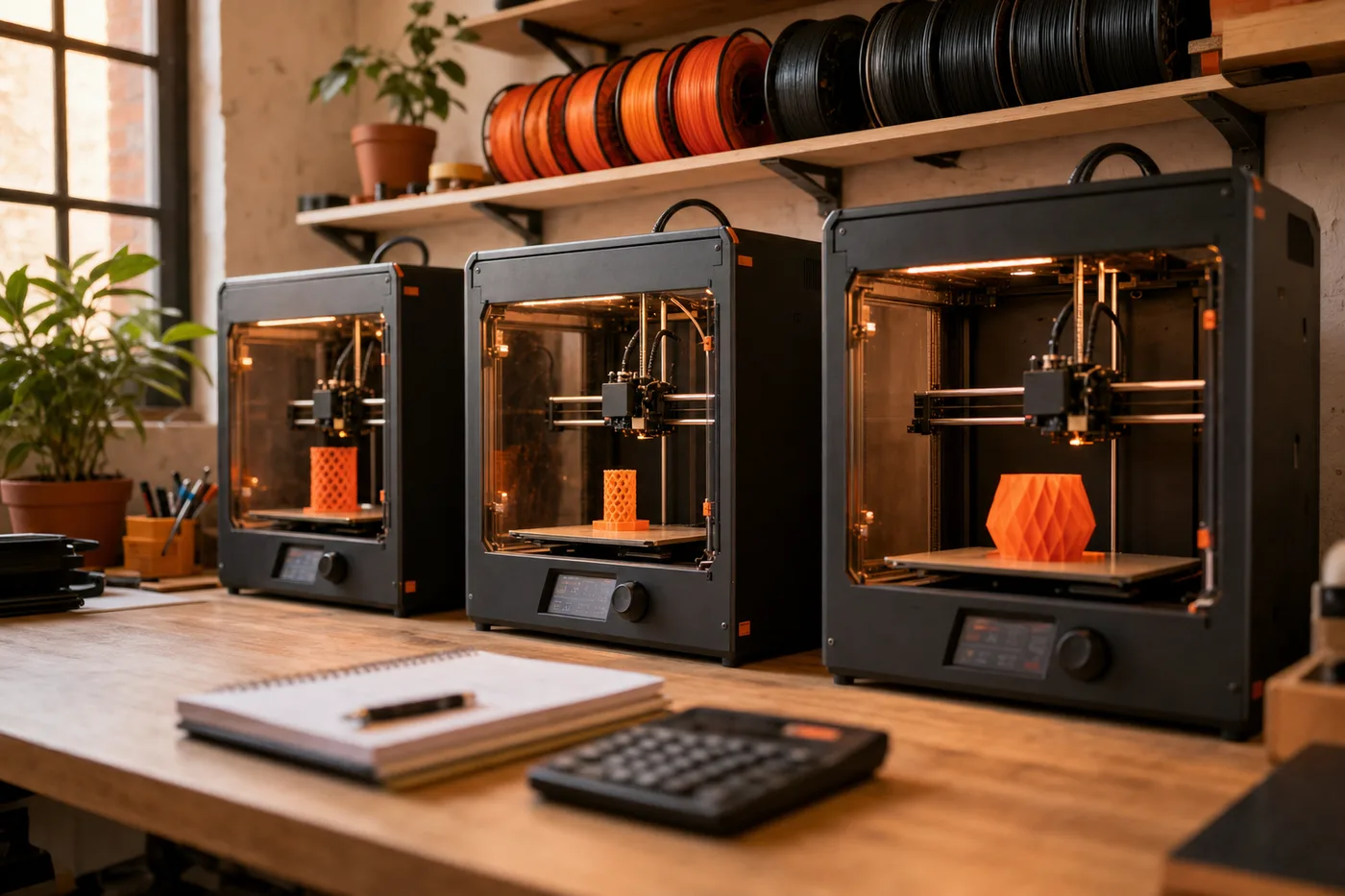
Three desktop 3D printers and filament in a warm, organized print workshop
Made by you.Your price should include your work.

From making it to selling it

The slicer finished its estimate. Your work has barely started.

The customer sends a file. The slicer reports a few dollars of filament, and a quick price feels easy to send. But you still have to check the model, prepare the plate, remove the supports, and finish the part. Those steps need your time even when the printer runs unattended.

A second attempt consumes more material and time before you have anything to deliver. A useful estimate joins the slicer's figures to the rest of the job, using your actual process rather than asking filament alone to represent your shop.

01 / Follow the work behind the price

The costs are specific.
Your calculation should be, too.

Start with the parts of your process that are easiest to leave out. Give each one a place in the cost of your finished product.

01

Grams are not the whole job

Supports, brims, and purge material change what leaves the spool. Support settings also affect removal. The finished object's weight is not always the quantity to use in your calculation.

Put it in your calculation

Use the total material consumed by the selected print settings.
02

Printer hours and your hours are different

An eight-hour print may need much less hands-on labor. It still occupies equipment and uses power. Meanwhile, setup and finishing need your attention even on a short print.

Put it in your calculation

Keep equipment time separate from active preparation and finishing.

03

The failed attempt still used the spool

A detached part consumes resources before delivery. An allowance based on your experience can make estimates more realistic. Counting the same loss in material waste and another blanket charge would exaggerate costs.

Put it in your calculation

Use one clear treatment for expected loss and review it against real work.

02 / See what the price leaves you

One finished product.
The cost behind it.

This fictional small fdm display stand — fictional usd example includes the materials, work and equipment costs listed alongside it. They add up to $11.00. Your own process, purchase prices and hourly rate will change the result.

At $20.00, there’s $9.00 left.

That’s after the costs listed in this example. Any unlisted packaging, fees and other expenses still need to come out of it. Move the price to explore the difference.

Illustrative USD example. Your costs and selling price are yours to choose.

Anatomy of a price

Small FDM display stand — fictional USD example

Example · USD
Filament + supports
$3.00
Equipment + energy
$2.00
Active labor — 15 min at $20/hour
$5.00
Packing + allocated overhead
$1.00
Cost in this example
$11.00
$20.00
$5.00Explore a selling price$30.00
Left after listed costs$9.00

45% margin
before other expenses

A fictional worked example, not a recommended price. Include any packaging, overhead, selling fees and applicable taxes not listed here before treating the remainder as profit. Changing the price doesn’t predict demand.

Make the next decision with the numbers visible

Turn the sliced model into a complete product cost

Our fictional USD example has $3 of material, $2 of equipment and power, $5 of active work, and $1 of packing and overhead. That is $11 before profit. Labor assumes fifteen minutes at an illustrative $20 hourly rate; these are teaching inputs, not suggested shop rates.

Enter your material quantities, machine time, and labor in CrafterBy. Save a product template and update it for the next variation. You can compare how another orientation or finish changes the whole job, beyond its filament weight.

Calculate my first product

03 / Put your costs somewhere useful

Know this product’s cost.
Keep it for the next order.

CrafterBy brings materials, active labor and equipment costs into a saved product. Explore the real app below.

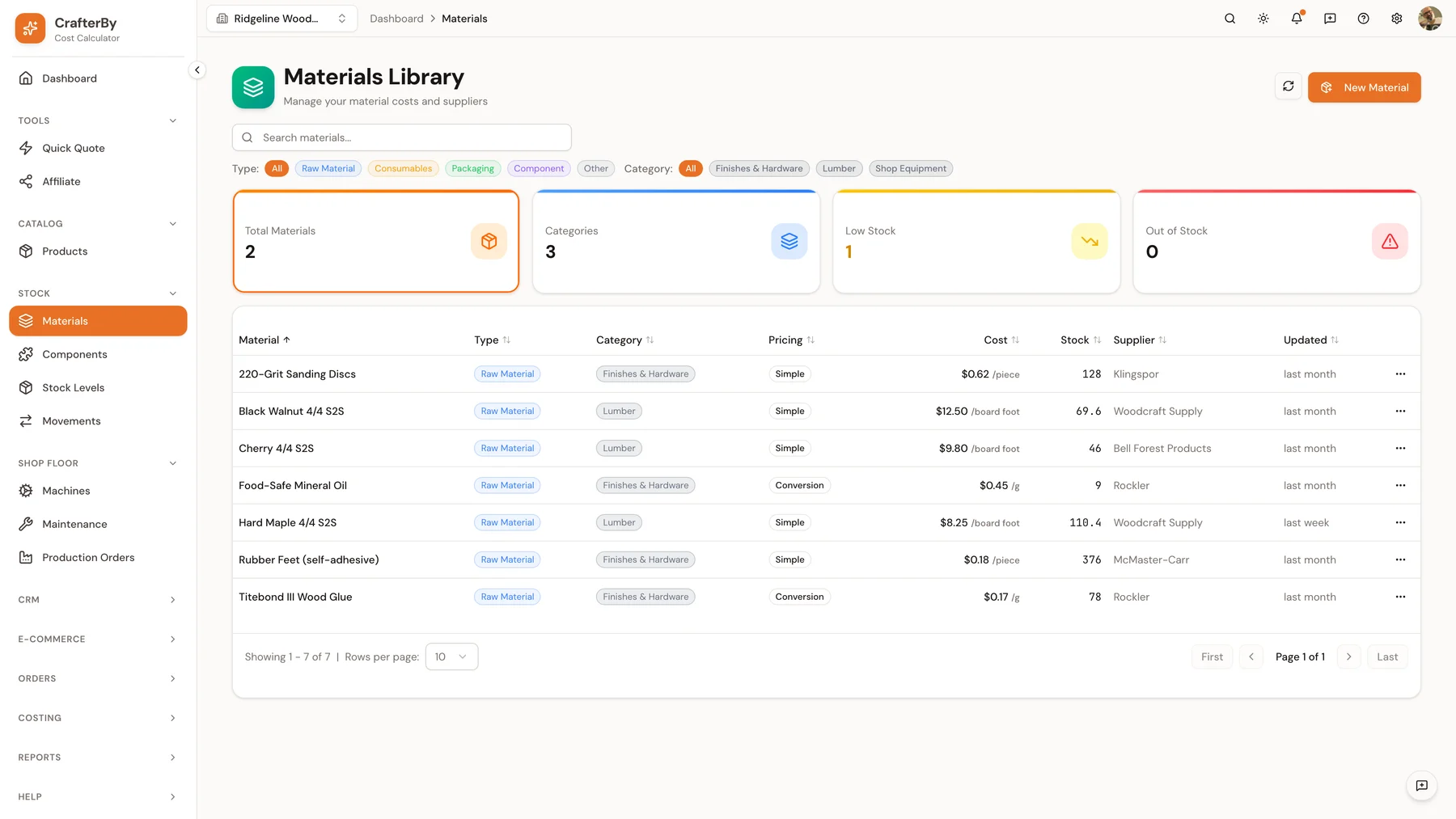
Keep pla, petg, abs and the other materials you use in one library. Record purchase prices and units, then use them in your product costs. Real app captures below contain sample woodworking data.

Inside CrafterBy / MaterialsActual app
CrafterBy’s Materials Library with unit prices, stock levels and suppliers in a sample woodworking account.

Your materials, organized · Real captures with sample woodworking data; your work uses the same tools.

View full size
Materials

Know what you paid and what you use.

Keep purchase prices, units and waste allowances with your materials. Buying a large pack and using a small amount should be part of the calculation, not another guess.

Product templates

Reuse the work behind the quote.

Save a familiar product’s materials and process as a starting point. Review the quantity, design and active time when the next order is different.

Cost & margin

Compare a price with the costs.

See what remains after the costs you entered. You choose the price; the breakdown helps you judge the work and the order before committing to it.

Before you make the next batch or quote

“My printer is already paid for.”

That changes your cash situation, but the equipment still has a working life and maintenance needs. Decide what equipment cost belongs in your calculation rather than treating ownership as proof that running it costs nothing.

Keep material, electricity, labor, and equipment assumptions separate. CrafterBy gives them a home alongside your products and material library. You still choose the selling price and review the figures against actual work.

Your first step is small

Start with one product.
Build from what you know.

Take one recently delivered print. Enter its total material use, then add the active minutes spent preparing and finishing it.

Create your free account, add the costs you know, then explore a selling price. Replace estimates with measured numbers as you learn from your own work.

Calculate my first product

Start free. See current plans and limits.

Before you start

Questions from your craft.
Answers you can use.

Does CrafterBy import or slice my STL file?

Enter figures from your slicer and workshop. This workflow does not promise STL analysis, automatic quoting, or printer integration. Keep your existing print tools and bring their relevant numbers into the calculation.

How do I price a print running overnight?

Include equipment time and energy for the run, plus your active preparation and finishing. Do not automatically treat every unattended machine hour as a full hour of hands-on labor.

Can I use this for resin parts?

Yes. Include resin consumed, wash and curing consumables, equipment time, and active finishing. Use your measured amounts rather than reusing an FDM template unchanged.

I’m only starting to sell. Is this for me?

Yes. You can begin with one product and the materials you already use. Take one recently delivered print. Enter its total material use, then add the active minutes spent preparing and finishing it. You don’t need a team or a large catalog to start understanding your costs.

Is the money left after these costs all profit?

At a $20.00 selling price, $9.00 remains after the $11.00 of costs listed in this fictional example. Any packaging, overhead, selling fees, shipping you cover or applicable taxes not listed here can reduce that amount. Include your active labor as a cost too; it is separate from the margin left afterward.

Can I try it before choosing a paid plan?

Yes. Create an account and start free with one product. Check the pricing page for current plan features and limits. You can compare the process with your existing notes or spreadsheet before deciding what you need.

Your work deserves a price you understand

Make the product.
Know what it costs.

Start with your materials, your process and your time.
Give the next price a reason behind it.

Calculate my first product

Free to start · Your costs, your price, your decision