Skip to content
CrafterBy

Cake & Confectionery cost & pricing calculator

$20 of ingredients.
The decorated cake?
$70 to make.

Your careful finish takes more than butter and flour. Put your preparation, decoration, and packaging into the price too.

This fictional USD example starts with $20 of ingredients and reaches $70 of listed costs. Build your own recipe calculation with your quantities and labor rate in CrafterBy.

Calculate my first product

Start free · Create an account, then add one product

Explore the cost example first
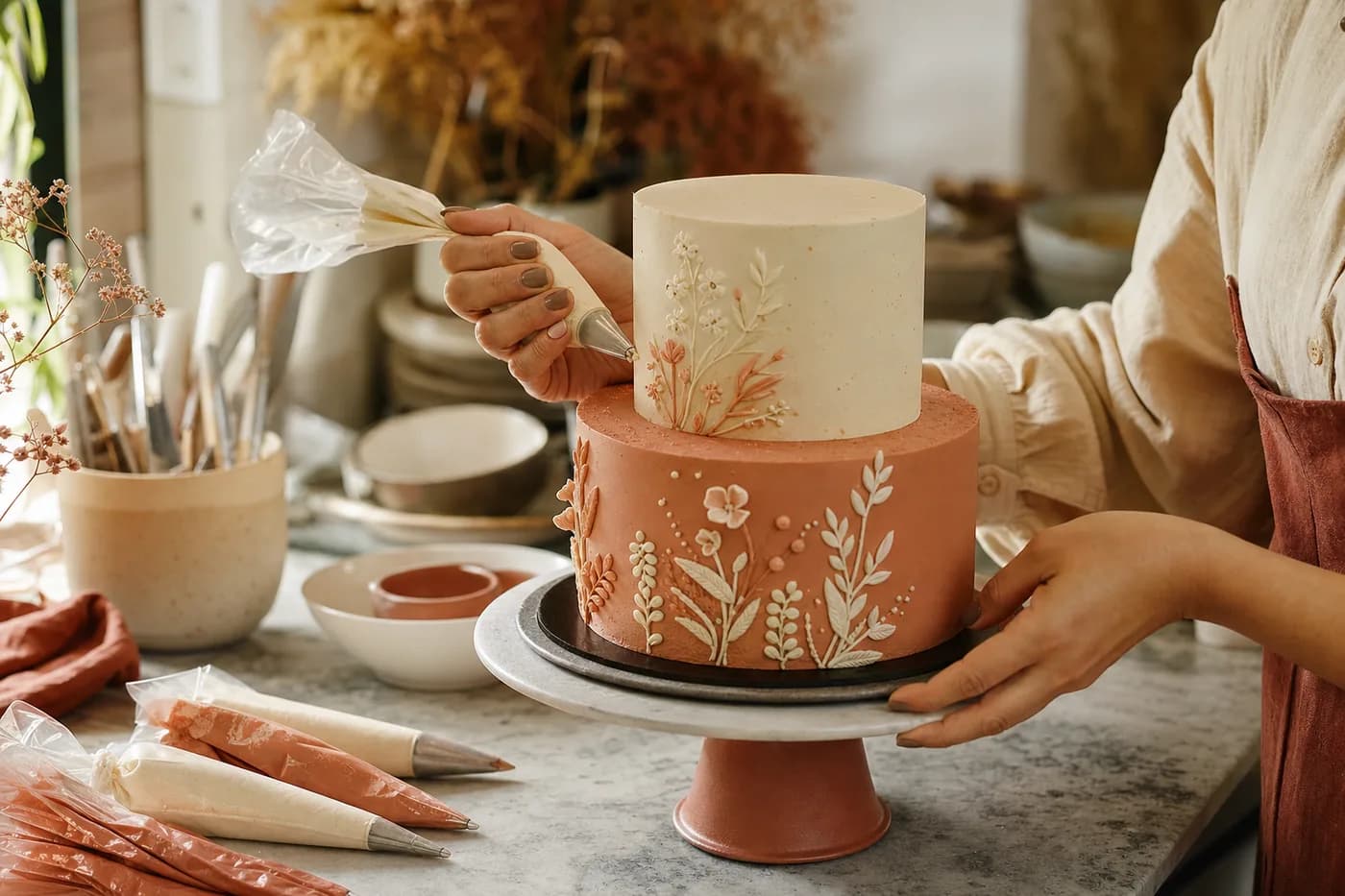
A carefully decorated cake and baking tools in a warmly lit artisan kitchen
Made by you.Your price should include your work.

From making it to selling it

The ingredients fit the budget. Your evening did not.

The cake is collected and the customer is delighted. You look around the kitchen: piping bags, bowls, the board you almost forgot, and the clock showing how long decoration really took. Ingredients were easy to price. The hours around them were easier to lose.

Two cakes with similar ingredients can need different filling, structure, and decoration. Ask what this order needs from your kitchen and your hands. Give those details a place before the price becomes a promise, rather than relying on a familiar ingredient multiplier.

01 / Follow the work behind the price

The costs are specific.
Your calculation should be, too.

Start with the parts of your process that are easiest to leave out. Give each one a place in the cost of your finished product.

01

The recipe ends before the decoration does

Mixing colors, smoothing a finish, piping borders, and assembling details take hands-on time. Filling, coating, and decorating are different tasks. An ingredient multiplier cannot describe how much of each the customer requested.

Put it in your calculation

Estimate preparation, assembly, and decoration separately.
02

“The same size” can mean a different order

Portion size, cake shape, and decorating details affect what you need. Serving and icing charts are guides, not guarantees. Cost the actual recipe and finish agreed with the customer.

Put it in your calculation

Tie the calculation to a specific cake and agreed scope.

03

The board and box leave with the cake

Boards, supports, boxes, and toppers belong to the order. Oven use and a sensible share of kitchen overhead matter too. Their inclusion should not depend on what you remember while typing a message.

Put it in your calculation

Keep packaging and equipment costs beside the ingredients.

02 / See what the price leaves you

One finished product.
The cost behind it.

This fictional decorated celebration cake — fictional usd example includes the materials, work and equipment costs listed alongside it. They add up to $70.00. Your own process, purchase prices and hourly rate will change the result.

At $100.00, there’s $30.00 left.

That’s after the costs listed in this example. Any unlisted packaging, fees and other expenses still need to come out of it. Move the price to explore the difference.

Illustrative USD example. Your costs and selling price are yours to choose.

Anatomy of a price

Decorated celebration cake — fictional USD example

Example · USD
Ingredients
$20.00
Active labor — 2 hours at $18/hour
$36.00
Oven + energy
$4.00
Packaging + allocated overhead
$10.00
Cost in this example
$70.00
$100.00
$35.00Explore a selling price$150.00
Left after listed costs$30.00

30% margin
before other expenses

A fictional worked example, not a recommended price. Include any packaging, overhead, selling fees and applicable taxes not listed here before treating the remainder as profit. Changing the price doesn’t predict demand.

Make the next decision with the numbers visible

Let your time appear next to the butter and flour

Our fictional USD cake uses $20 of ingredients, $36 of active labor, $4 of oven and energy, and $10 of packaging and overhead: $70 before profit. Labor assumes two hours at an illustrative $18 rate. Your recipe, time, and chosen rate will differ.

Build the recipe in CrafterBy with ingredient quantities, equipment use, and labor. Save a product template. When a customer requests a detailed finish, revisit decorating time and materials rather than treating the change as a few more ingredients.

Calculate my first product

03 / Put your costs somewhere useful

Know this product’s cost.
Keep it for the next order.

CrafterBy brings materials, active labor and equipment costs into a saved product. Explore the real app below.

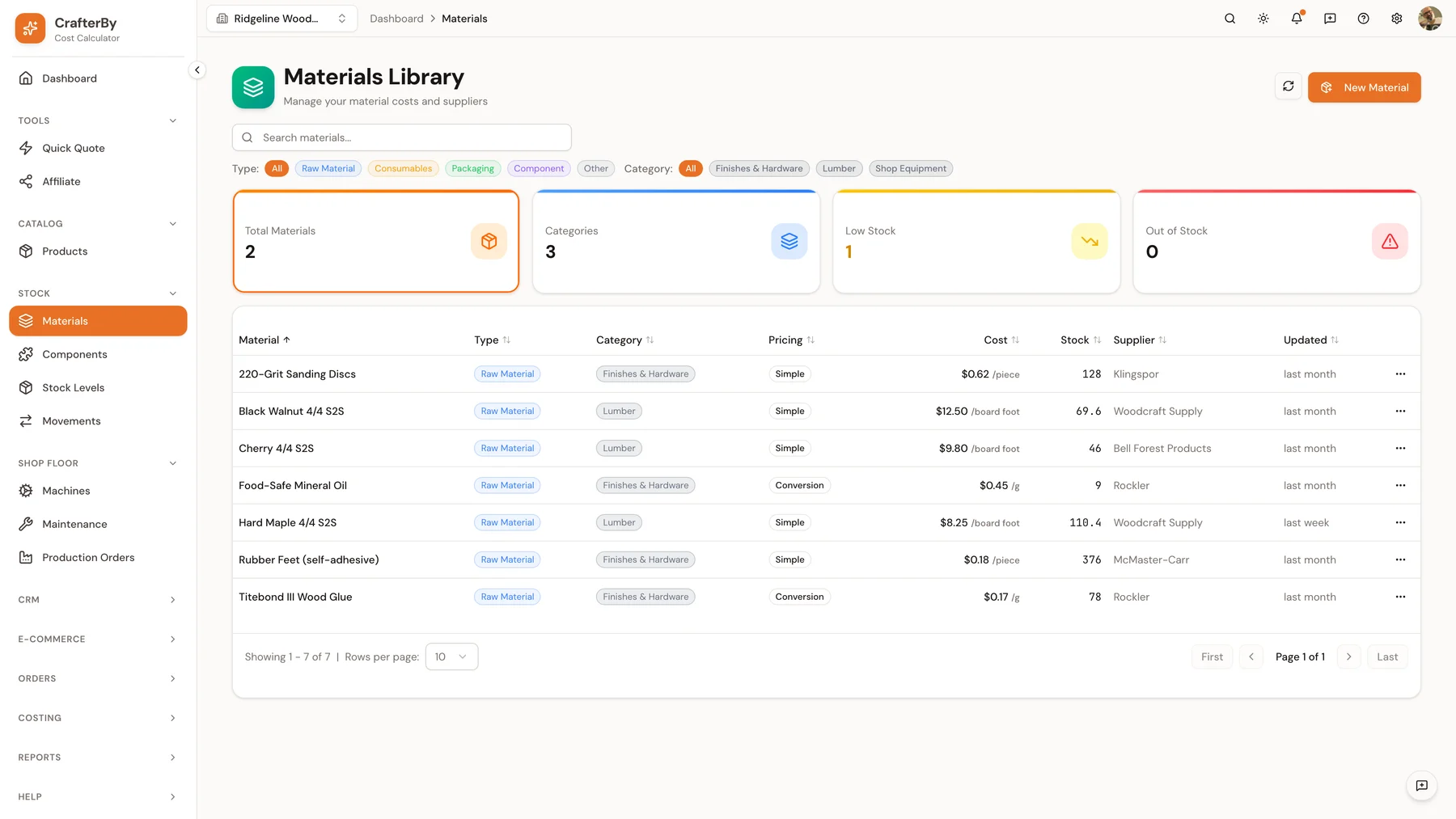
Keep flour, butter, chocolate and the other materials you use in one library. Record purchase prices and units, then use them in your product costs. Real app captures below contain sample woodworking data.

Inside CrafterBy / MaterialsActual app
CrafterBy’s Materials Library with unit prices, stock levels and suppliers in a sample woodworking account.

Your materials, organized · Real captures with sample woodworking data; your work uses the same tools.

View full size
Materials

Know what you paid and what you use.

Keep purchase prices, units and waste allowances with your materials. Buying a large pack and using a small amount should be part of the calculation, not another guess.

Product templates

Reuse the work behind the quote.

Save a familiar product’s materials and process as a starting point. Review the quantity, design and active time when the next order is different.

Cost & margin

Compare a price with the costs.

See what remains after the costs you entered. You choose the price; the breakdown helps you judge the work and the order before committing to it.

Before you make the next batch or quote

“My customers compare prices per serving.”

You can present a price that way while calculating the whole cake first. Servings help describe what the customer receives; they do not erase the time needed for a particular design.

If the requested decoration does not fit the budget, a simpler finish may be a better conversation than quietly removing your labor from the price. Cost visibility supports that conversation. It cannot guarantee an order, and it does not decide what your work should earn.

Your first step is small

Start with one product.
Build from what you know.

Choose your last decorated cake. Enter its ingredient quantities and box, then add the active time from preparation through finishing.

Create your free account, add the costs you know, then explore a selling price. Replace estimates with measured numbers as you learn from your own work.

Calculate my first product

Start free. See current plans and limits.

Before you start

Questions from your craft.
Answers you can use.

Should I charge labor for every hour a cake cools?

Separate active work from elapsed time. Cooling does not automatically equal hands-on labor, though it occupies space and affects scheduling. Include relevant kitchen costs without counting the same expense twice.

Can I reuse the calculation for a larger cake?

Start from a template, then check quantities, structure, equipment time, and decoration again. A larger cake does not scale every task by the same factor.

What about leftover buttercream?

Distinguish usable ingredients from waste. Count what the order consumes with a realistic allowance for loss. Do not assume every leftover will be used; apply your own food-handling requirements.

I’m only starting to sell. Is this for me?

Yes. You can begin with one product and the materials you already use. Choose your last decorated cake. Enter its ingredient quantities and box, then add the active time from preparation through finishing. You don’t need a team or a large catalog to start understanding your costs.

Is the money left after these costs all profit?

At a $100.00 selling price, $30.00 remains after the $70.00 of costs listed in this fictional example. Any packaging, overhead, selling fees, shipping you cover or applicable taxes not listed here can reduce that amount. Include your active labor as a cost too; it is separate from the margin left afterward.

Can I try it before choosing a paid plan?

Yes. Create an account and start free with one product. Check the pricing page for current plan features and limits. You can compare the process with your existing notes or spreadsheet before deciding what you need.

Your work deserves a price you understand

Make the product.
Know what it costs.

Start with your materials, your process and your time.
Give the next price a reason behind it.

Calculate my first product

Free to start · Your costs, your price, your decision